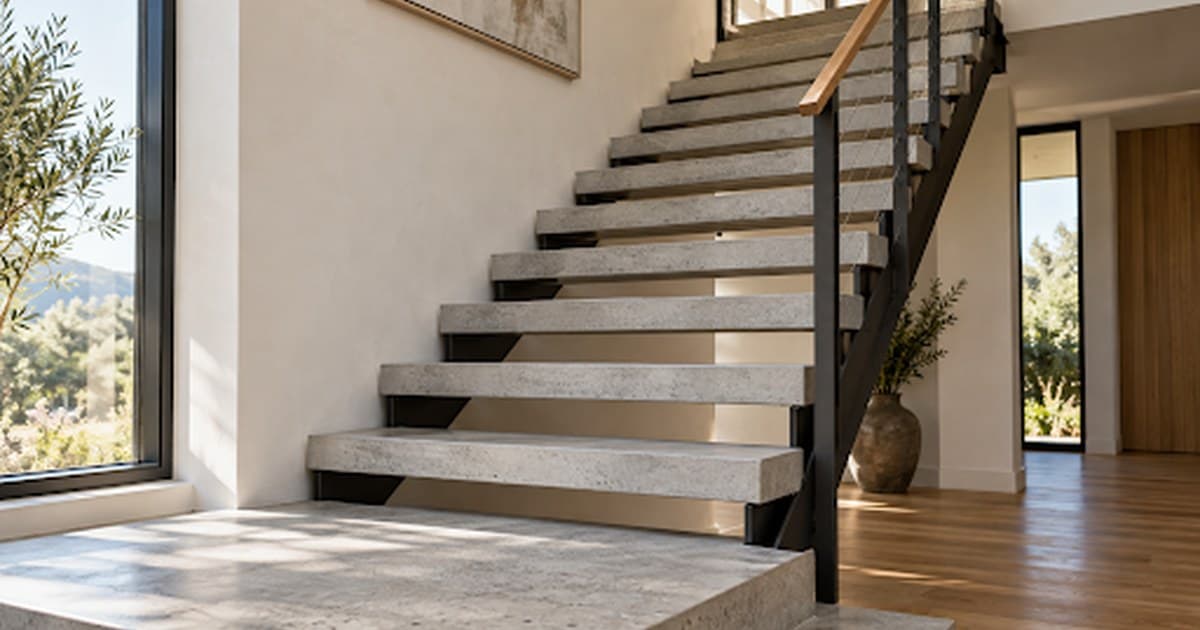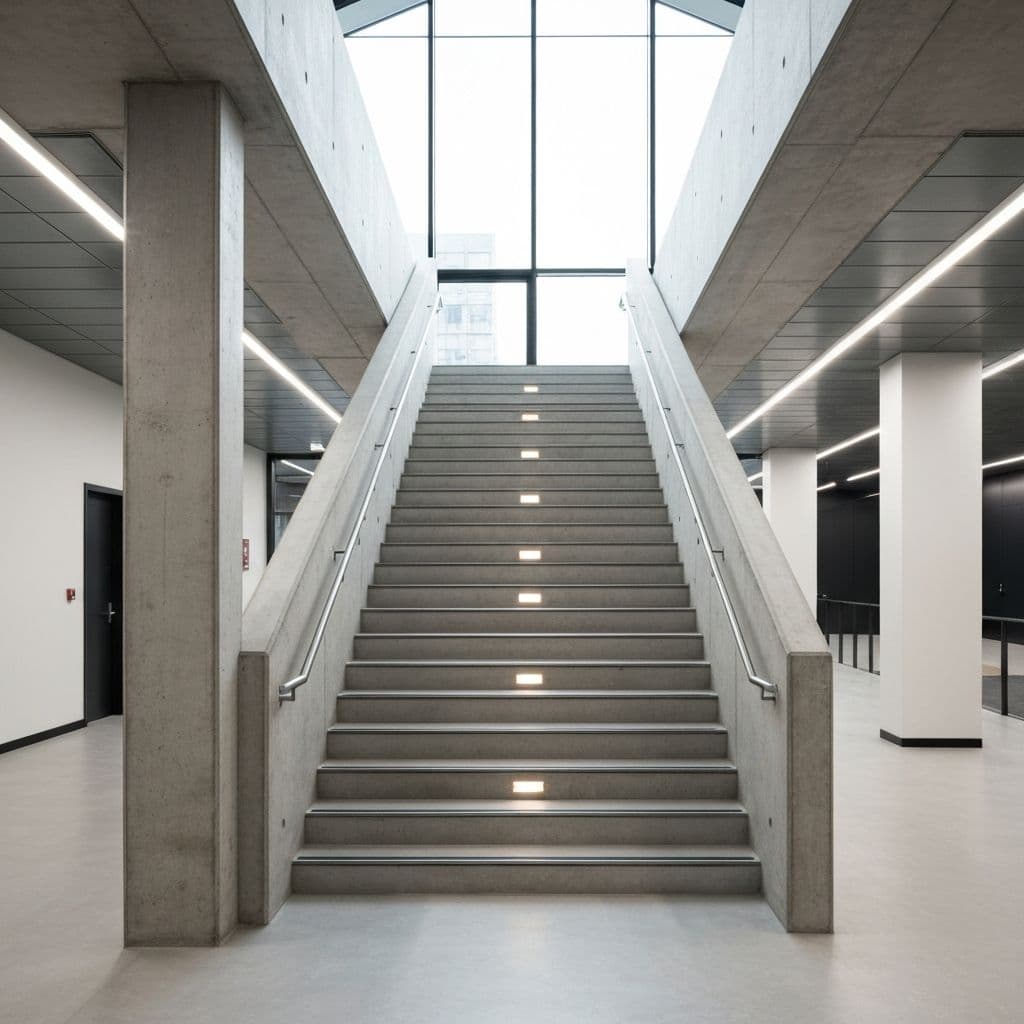
Concrete stairs improve commercial building safety through fire resistance, slip-resistant surfaces, load-bearing stability, and code compliance. Here is how they protect occupants and owners.
Concrete stairs improve commercial building safety in four measurable ways: they resist fire and preserve a protected egress route, they can be cast with slip-resistant surfaces that cut falls, they carry heavy loads without flexing or weakening, and they make it easier to meet the building codes that govern commercial egress. For a commercial property, where occupant safety and owner liability are both at stake, the staircase material is a decision with real consequences. Here is how concrete stairs deliver on each safety front.
Fire Resistance and Protected Egress
Fire safety is a defining requirement in commercial buildings, and this is where concrete stairs hold a clear advantage. Concrete is non-combustible—it won't ignite, and it won't feed or accelerate a fire the way a wood stair can. Just as important, concrete maintains its structural integrity under high heat far longer than unprotected steel, which can soften and lose load capacity as temperatures climb. That performance keeps the stairwell intact as an evacuation route during the critical minutes of an emergency, giving occupants more time to get out safely.
Slip-Resistant Surfaces
Slips and falls are among the most frequent and costly accidents in commercial settings. Concrete stairs can be cast with textured surfaces, grooved nosings, and anti-slip coatings that maintain traction even when the steps are wet—an everyday concern in lobbies, entrances, and stairwells exposed to tracked-in rain or snow. Adding a high-visibility nosing strip helps people judge each step's edge, reducing missteps. These finishes are built into the unit rather than added on, so the traction doesn't wear away with use.
Load-Bearing Stability
Commercial stairs carry constant, heavy traffic and sometimes equipment or furniture being moved between floors. Reinforced concrete stairs are engineered to a defined load rating and cast to precise tolerances, so they stay firm and stable under that demand. Unlike metal stairs that can develop flex, vibration, or loosened connections over time, a concrete stair remains solid underfoot. That stability reduces the wobble and movement that contribute to falls and reassures occupants using the stair every day—and during an evacuation.
Code Compliance Made Easier
Commercial buildings must satisfy strict requirements for egress width, riser and tread dimensions, fire ratings, and structural capacity. Concrete stairs help meet those standards: their fire resistance supports fire-safety codes, their engineered strength satisfies structural requirements, and they accommodate the handrails and dimensional consistency that accessibility and egress codes demand. Building to code from the start avoids costly violations, failed inspections, and the liability that comes with a non-compliant stairwell.
Durability That Sustains Safety
Safety isn't a one-time condition—it has to hold up over years of use. Because concrete resists cracking, warping, and weather damage, the stair's safety features don't degrade the way they can with materials that rot or rust. Low maintenance requirements mean fewer hazards develop unnoticed between inspections, and a long service life means the stair keeps performing to its original specification. For owners, that durability translates into both safer stairwells and lower lifetime cost.
A Smart Investment in Commercial Safety
Fire resistance, slip resistance, structural stability, code compliance, and lasting durability together make concrete stairs a foundational safety feature for any commercial building. Choosing them protects occupants and reduces an owner's liability exposure for decades.
If you are designing or upgrading a commercial stairwell, explore our commercial concrete stair treads and request a quote built to your building's safety requirements.