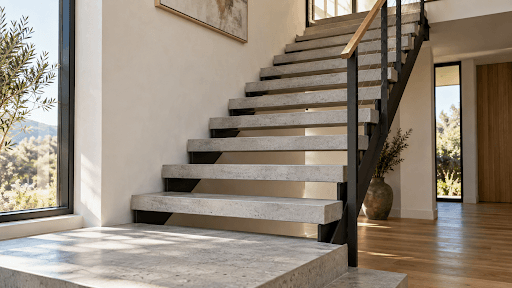
A buyer's guide to precast concrete stair treads covering standard dimensions, finish and slip-resistance options, what they cost per tread, and how long they take to fabricate and ship.
Precast Concrete Stair Treads: Sizes, Finishes, Pricing, and Lead Times
If you are pricing out a staircase and comparing precast concrete stair treads to alternatives like poured-in-place, steel, or wood, the questions most people ask are usually the same. What sizes are standard, what do they usually cost, how long do they take to make, and can they ship directly to my job site?
This guide answers those questions with the same prices we quote every day at Newbold Stone.
What a Precast Stair Tread Is
A precast concrete stair tread is a single cast piece that forms the walking surface of a single step. Each tread is fabricated in a facility and then cured, finished, and sealed before it leaves for the job site. Treads are then set onto steel stringers, concrete or masonry risers, or embedded connections for floating stairs.
Because the treads arrive finished, installation is fast and the results are consistent across all of our projects. That is the main reason contractors order precast concrete stair treads as opposed to forming and pouring them on site.
Standard Sizes and Thicknesses
Every stair tread we make is custom, but most projects fall within these ranges:
- Depth: 11 to 14 inches
- Width: 36 to 72 inches
- Thickness: 1.5 to 4 inches
Commercial code under IBC generally calls for a minimum tread depth of 11 inches and a maximum riser height of 7 inches. Residential codes can allow for slightly steeper stairs. We can also produce non-standard dimensions along with matching landing slabs, risers, and coping pieces so the whole stair visually comes together as one piece.
Nosing profiles are available in standard square or bullnose shapes, as well as custom profiles to match an architect's drawings.
Finishes and Slip Resistance
Surface finish affects both the look and how the tread performs when walked upon. These are some common options we produce:
- Smooth or honed: modern appearance with a better grip compared to a high polish
- Polished: glass-like sheen, commonly paired with abrasive nosing strips or textured borders to provide traction
- Sandblasted: matte, lightly textured surface that can hide wear well
- Exposed aggregate: stone showing through the surface for a natural look and strong slip resistance
- Abrasive inlays: added to any finish to match or exceed friction requirements
Polished concrete stair treads are a popular request for interior residential work. For exterior steps or high-traffic commercial stairwells, we will usually recommend sandblasted, exposed aggregate, or a honed finish with an abrasive nosing.
Integral color is mixed into the concrete itself, so it will maintain its appearance over time, color-wise. We can walk you through our color options during the quoting process and are always happy to make recommendations based on your project.
Code Compliance
Precast stair treads from Newbold Stone are engineered to meet IBC, ADA, and local building codes. Slip-resistant surface treatments are available that match code requirements for coefficient of friction, and we can provide compliance documentation to support your project file. For a closer look at why this matters, read our guide on code compliance for precast stairs.
What DCOF Means for Stair Treads
Slip resistance is measured as DCOF, or dynamic coefficient of friction. It is a dimensionless ratio that describes how much grip a surface has under a moving foot. The higher the number, the less likely someone might slip.
The industry test method is ANSI A326.3. Under that standard, hard surface flooring in level interior spaces that presumably will be walked on wet should test at a wet DCOF of 0.42 or higher. Exterior surfaces and areas with constant water exposure are usually held to higher thresholds.
Finish drives the DCOF result. A polished tread will test lower than a sandblasted or exposed aggregate tread, which is why we suggest pairing polished finishes with abrasive nosing strips or textured borders. If your project specifies a DCOF minimum, make sure to mention that to our team during the quoting process and we will recommend a finish that meets it.
Fire Resistance
Concrete is inherently fire-resistant and will not burn, smoke, or release toxic fumes. Commercial concrete stair treads contribute to fire-rated stairwell assemblies and meet means-of-egress requirements. The rating depends on the complete assembly design.
Reinforcement and Floating Stairs
Treads are reinforced with steel or fiber depending on span, load, and application. For floating or cantilevered staircases, treads will require specific engineering for support and load distribution. We work alongside your structural engineer and can cast embedded steel connections directly into the tread so it cleanly anchors to the wall or stringer.
If you are planning a floating staircase, make sure to share the span and support detail early to ensure we are aligned on your expectations. It can affect tread thickness and reinforcement, and both need to be locked in prior to the mold being created.
How Much Precast Stair Treads Cost
Precast concrete stair treads typically range from $200 to $750+ per tread. Where a project lands in that range depends on:
- Size and thickness
- Finish (exposed aggregate and polished finishes take more labor than sandblasted)
- Nosing profile and any custom shapes
- Reinforcement and embedded connections
- Integral color
Volume discounts can be offered for larger commercial orders. We make sure to include shipping and installation (if needed) in the quote we provide to prevent surprises near project completion.
For a quick comparison, poured-in-place stairs carry formwork, finishing labor, and cure time on site. This means you'll need to spend extra resources to preserve the site during curing to prevent mishaps and concrete contamination. Precasting keeps that work in our facility and shortens the construction schedule so you can keep your focus on the other moving parts.
Lead Times
Standard orders typically ship within 3 to 4 weeks once we receive order approval. Large orders or custom specifications may have a lead time of 4 to 6 weeks. Rush orders can often be accommodated when needed, and large commercial projects can be phased so treads arrive as each floor is ready.
Ordering and Delivery
Newbold Stone fabricates every tread at our facility in Del Valle, Texas, and delivers throughout the continental United States. Treads are packaged for freight to prevent damage in transit, and delivery can be coordinated with your construction schedule. If your project is outside Texas, here is what to expect when ordering custom architectural concrete out of state.
To order concrete stair treads, send us:
- Number of treads and any landings
- Depth, width, and thickness (or the architect's drawings)
- Interior or exterior application
- Preferred finish and nosing profile
- Project location and target install date
We have been working directly with architects, contractors, and building owners for the past 25 years and have completed more than 500 custom projects across the United States.
Ready to Price Your Project?
If you need commercial concrete stair treads for an office, school, or healthcare building, or custom concrete stair treads for a residential staircase, request a quote with your specs and we will send detailed pricing. You can also browse finished work on our stair tread page.